OAN Staff Cory Hawkins and Brooke Mallory
3:16 PM – Thursday, January 8, 2026
The Russian Foreign Ministry issued a strong rejection of a recent Western proposal for post-war security guarantees to Ukraine. The proposal emerged from talks involving the U.S., Ukraine and European allies, and included elements like European-led peacekeeping forces and American-backed monitoring.
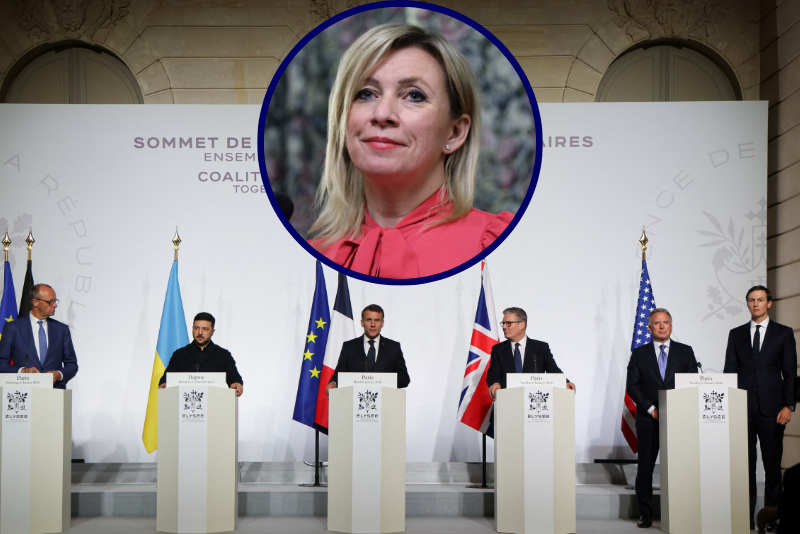
On Thursday, Russia’s Foreign Ministry, through Kremlin spokeswoman Maria Zakharova, pushed back against the latest U.S.-backed security-guarantee framework, arguing that the proposal was not aimed at peace — but at further militarizing Ukraine and escalating the conflict.
The proposal that Russia rejected isn’t solely, or explicitly, an offer to end the war, at least in the sense of a formal peace treaty that would immediately stop fighting. Rather, Western officials and allies came to an agreement of a unique framework tied to a future peace settlement — a set of commitments for Ukraine’s defense and deterrence once a ceasefire or peace agreement is in place.
The 20-point, and earlier “28-point,” plan was described by Democrats and Ukrainian officials as being “favorable” to Russia, when it leaked in late 2025. What Russia rejected on Thursday is the updated “Europeanized” version of that plan — specifically the “security guarantees” that were added during the Paris Summit this week.
Zakharova issued her scathing rebuke on Thursday, branding the U.S., Europe, and Ukraine a genuine “axis of war.” Dismissing the plan as “dangerous and destructive,” she warned that any foreign troops deployed to Ukrainian soil would be treated as legitimate military targets.
“The document turned out to be extremely far from a peace settlement. The declaration is not aimed at achieving a lasting peace and security but rather at continuing the militarization, escalation and further conflict aggravation,” Zakharova stated, speaking for the Russian Ministry.
“Its core element is the deployment of ‘a multinational force’ on Ukrainian territory that the coalition will have to form to contribute to the ‘rebuilding’ of the Ukrainian armed forces and ‘support deterrence’ following the cessation of the hostilities,” she added.
The Kremlin’s rejection follows a high-level summit in Paris on Tuesday, where President Trump’s peace envoys, Steve Witkoff and Jared Kushner, joined European leaders in backing a new five-point security framework. These guarantees are intended to anchor the broader 20-point peace plan, providing Ukraine with legally binding defense commitments and a U.S.-led monitoring mechanism if a ceasefire is reached.
“Critical long term military assistance” was promised to Kyiv, including additional military aid and sanctions “in case of a future armed attack by Russia,” a “European-led” multinational peacekeeping force, and “mutually beneficial defense cooperation with Ukraine,” the Paris Declaration language reads in a trilateral agreement signed on Tuesday by French President Emmanuel Macron, British Prime Minister Keir Starmer and Ukrainian President Volodymyr Zelensky.
While the document was signed by those three leaders, it was drafted and endorsed by the “Coalition of the Willing” — a group of roughly 30 nations — and the signing ceremony was attended by Witkoff and Kushner.
Russia’s specific objections include the deployment of a multinational peacekeeping force, the provision of U.S.-supplied weapons purchased directly by European countries, and closer integration of Ukraine’s military with NATO’s defense-industrial infrastructure.
“The new militarist declarations of the so-called Coalition of the Willing and the Kyiv regime are forming a true axis of war,” the Russian Ministry continued. “Its participants’ plans are becoming increasingly more dangerous and destructive for the future of the European continent and its residents, who are also forced by Western politicians to pay for such ambitions out of their own pockets.”
Adding to current diplomatic friction, Russia has condemned the U.S. seizure of the oil tanker Marinera — formerly known as the Bella 1 — as a “gross violation” of international maritime law. The vessel, part of a “shadow fleet” linked to Iranian and Venezuelan oil, was intercepted by U.S. European Command in the North Atlantic after a two-week pursuit.
While Moscow argues the seizure breaches the 1982 UN Convention on the Law of the Sea (UNCLOS), Washington maintains the ship’s last-minute re-flagging to Russia was a fraudulent attempt to evade sanctions, rendering the vessel “stateless” and subject to federal warrants. Additionally, the United States is not a signatory to the UNCLOS.
“The use of force in international waters against a civilian vessel can only be interpreted as a gross violation of fundamental principles and norms,” Moscow’s Foreign Ministry said in a statement. “… This constitutes a material infringement of the legitimate rights and interests of the vessel owner.
U.S. officials declared that they acted within their legal authority to seize the Marinera for violating the ongoing U.S. naval blockade of Venezuelan oil ports.
Stay informed! Receive breaking news blasts directly to your inbox for free. Subscribe here. https://www.oann.com/alerts
What do YOU think? Click here to jump to the comments!
Sponsored Content Below