OAN Staff Brooke Mallory
1:15 PM – Friday, February 20, 2026
The U.S. Supreme Court (SCOTUS) voted 6-3 on Friday to invalidate President Donald Trump’s “Liberation Day” tariffs, ruling that they were not authorized by the 1977 International Emergency Economic Powers Act (IEEPA). The ruling does not, however, preclude the use of different statutory mechanisms for tariffs.
Nonetheless, the decision still dismantles the cornerstone of the Trump administration’s “America First” trade strategy and sets a definitive boundary on the 47th president’s ability to reshape the global economy by fiat.
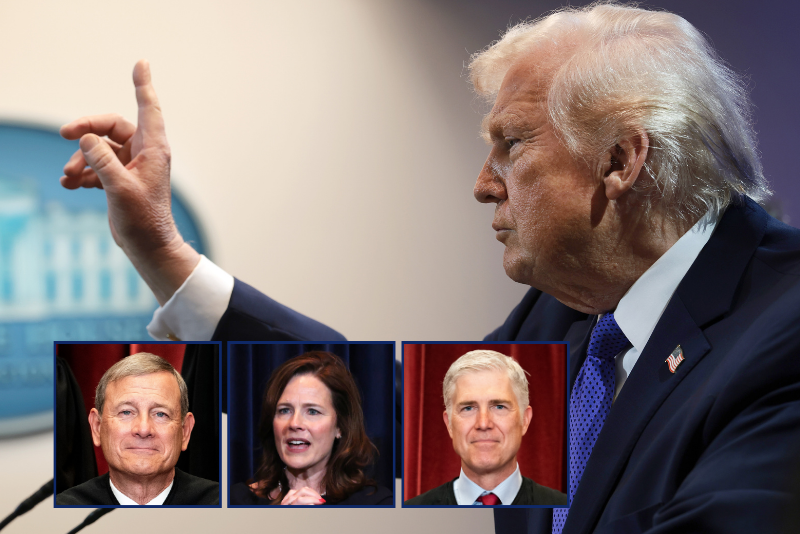
Following the ruling, President Trump responded defiantly, announcing plans for new temporary tariffs and vowing workarounds, calling the decision “deeply disappointing” and a “disgrace.” He was reportedly informed of the ruling during a meeting with governors.
In October, while highlighting his tariff achievements, Trump told reporters that his tariff regime had prevented a nuclear confrontation between India and Pakistan, threatening both countries with 200% to 250% “reciprocal” tariffs if hostilities did not subside.
The president held a press conference this Friday afternoon vowing to use these “powerful alternatives” to keep his trade agenda alive.
It is worth noting that the ruling is narrow — as it only blocks this specific IEEPA use. It does not prevent President Trump from pursuing tariffs via other statutory means, such as sector-specific tariffs imposed under other laws.
| Statute | What it is | How Trump could utilize it |
| Section 122 (Trade Act of 1974) | Balance-of-payments authority: Allows the U.S. president to impose tariffs of up to 15% for up to 150 days to address serious trade deficits. | The immediate fix: Hours after the ruling today, President Trump announced he would sign an order for a 10% global tariff under this law. It is fast, but temporary without Congressional approval. |
| Section 232 (Trade Expansion Act of 1962) | National security: Allows the U.S. president to impose unlimited tariffs on goods that “threaten to impair national security.” | The unaffected shield: The SCOTUS ruling does not touch existing Section 232 tariffs, like those on steel and aluminum. The administration is currently expanding these to include “critical minerals” and “semiconductors.” |
| Section 201 (Trade Act of 1974) | Global safeguards: Allows tariffs (up to 50%) if a surge of imports “seriously injures” a domestic industry. | The targeted option: Unlike the broad “Liberation Day” tariffs, this is used for specific industries. Trump mentioned he may use this to protect the U.S. lumber and auto sectors. |
The ruling triggered immediate volatility in the markets. While the S&P 500 rose 0.5% on hopes of lower costs for businesses, Treasury yields ticked up as investors weighed the loss of revenue intended to fund the “One Big Beautiful Bill” tax cuts.
Writing for the majority, Chief Justice John Roberts argued that while the IEEPA allows the president to regulate commerce during national emergencies, it does not grant “unbounded” power to levy taxes.
“When Congress has delegated its tariff powers, it has done so in explicit terms and subject to strict limits. Had Congress intended to convey the distinct and extraordinary power to impose tariffs, it would have done so expressly, as it consistently has in other tariff statutes,” Chief Justice John Roberts wrote.
The 6-3 decision saw an alignment of the court’s three liberal justices alongside George Bush-appointed Chief Justice Roberts and Trump-appointed Justices Neil Gorsuch and Amy Coney Barrett.
Speaking on Friday’s SCOTUS decision, the GOP president reiterated a shift in legal tactics. He vowed to bypass the ruling — which specifically limited his powers under the IEEPA — by invoking alternative statutory authorities.
“Today, the Supreme Court decided that Congress, despite giving the president the ability to “regulate imports”, didn’t actually mean it. This is lawlessness from the Court, plain and simple. And its only effect will be to make it harder for the president to protect American industries and supply chain resiliency. President Trump has a wide range of other tariff powers and he will use them to defend American workers and advance this administration’s trade priorities,” Vice President JD Vance responded on X after the ruling.
The Refund Dilemma
Following the High Court’s decision to invalidate the “Liberation Day” tariffs, the Treasury Department now faces a logistical and fiscal dilemma. With an estimated $170 billion to $175 billion already collected under the now-defunct IEEPA authority, corporate giants — including Costco, Alcoa, and Revlon — have joined over 1,500 other companies in filing “protective” lawsuits to recoup their payments.
Since the Supreme Court did not provide a specific mechanism for repayment, the administration now faces years of complex litigation as it attempts to hold onto the revenue while businesses demand immediate restitution with interest.
Sector Impact
The ruling provides a critical financial cushion for builders and manufacturers by curbing runaway inflation on essential hardware. Specifically, the removal of emergency tariffs is expected to spark a limited but significant drop in the “landed cost” of specialized machinery — most notably the complex components required for large-scale HVAC units and high-capacity electrical infrastructure.
Statutory Survival
While the High Court invalidated “emergency” tariffs, industry-specific duties remain untouched because they rest on a different legal foundation. Specifically, the 25% tariff on steel and 10% on aluminum — along with heavy duties on foreign automobiles — persist since they were enacted under Section 232 of the Trade Expansion Act.
Since these were justified by formal Department of Commerce “national security” findings rather than general executive emergencies, Friday’s ruling lacks the jurisdiction to overturn them.
Dissent
Led by Justices Brett Kavanaugh, Clarence Thomas, and Samuel Alito, the Court’s conservative minority issued a stinging rebuttal to the majority’s narrowing of executive power. Writing for the dissent, Justice Kavanaugh characterized tariffs not as an extraordinary overreach, but as a “traditional and common tool” historically utilized by the Executive Branch to manage international commerce.
He cautioned that by stripping President Trump of this specific authority under IEEPA, the Court has invited “serious practical consequences” — most notably a massive fiscal shock to the U.S. Treasury, which stands to lose billions in anticipated revenue previously earmarked for federal stability.
What’s Next
Following the ruling, jurisdiction now shifts back to the U.S. Court of International Trade (CIT). This specialized body will be tasked with the massive undertaking of vacating the previous tariff orders and establishing a structured framework for liquidating and refunding the billions in “emergency” duties collected from thousands of domestic importers over the past year.
Posting to Truth Social shortly after the ruling, President Trump responded to the decision by characterizing the decision as a disaster for Americans.
“The Supreme Court’s Ruling on TARIFFS is deeply disappointing! I am ashamed of certain Members of the Court for not having the Courage to do what is right for our Country. I would like to thank and congratulate Justices Thomas, Alito, and Kavanaugh for your Strength, Wisdom, and Love of our Country, which is right now very proud of you. When you read the dissenting opinions, there is no way that anyone can argue against them. Foreign Countries that have been ripping us off for years are ecstatic, and dancing in the streets — But they won’t be dancing for long! The Democrats on the Court are thrilled, but they will automatically vote “NO” against ANYTHING that makes America Strong and Healthy Again. They, also, are a Disgrace to our Nation. Others think they’re being “politically correct,” which has happened before, far too often, with certain Members of this Court when, in fact, they’re just FOOLS and “LAPDOGS” for the RINOS and Radical Left Democrats and, not that this should have anything to do with it, very unpatriotic, and disloyal to the Constitution. It is my opinion that the Court has been swayed by Foreign Interests, and a Political Movement that is far smaller than people would think — But obnoxious, ignorant, and loud!”
“This was an important case to me, more as a symbol of Economic and National Security, than anything else. The Good News is that there are methods, practices, Statutes, and other Authorities, as recognized by the entire Court and Congress, that are even stronger than the IEEPA TARIFFS, available to me as President of the United States of America and, in actuality, I was very modest in my “ask” of other Countries and Businesses because I wanted to do nothing that could sway the decision that has been rendered by the Court,” Trump continued.
“I have very effectively utilized TARIFFS over the past year to, MAKE AMERICA GREAT AGAIN. Our Stock Market has just recently broken the 50,000 mark on the DOW and, simultaneously, 7,000 on the S&P, two numbers that everybody thought, upon our Landslide Election Victory, could not be attained until the very end of my Administration — Four years! TARIFFS have, likewise, been used to end five of the eight Wars that I settled, have given us Great National Security and, together with our Strong Border, reduced Fentanyl coming into our Country by 30%, when I use them as a penalty against Countries illegally sending this poison to us. All of those TARIFFS remain, but other alternatives will now be used to replace the ones that the Court incorrectly rejected,” the president concluded.
Stay informed! Receive breaking news alerts directly to your inbox for free. Subscribe here. https://www.oann.com/alerts
What do YOU think? Click here to jump to the comments!
Sponsored Content Below