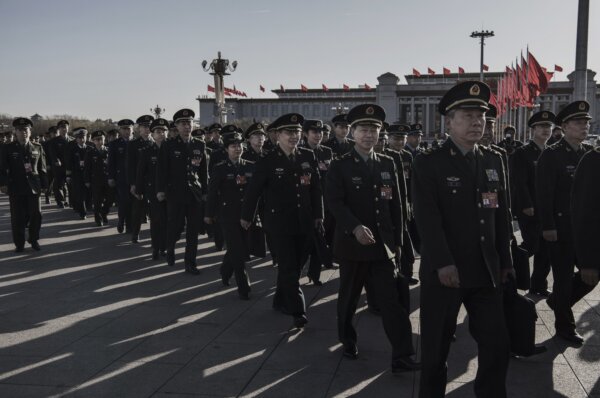
 Whether officially declared or not, the Chinese Communist Party (CCP) has been conducting a non-kinetic war against the United States throughout the 21st century.
Most Americans have never heard of the 1999 publication of “Unrestricted Warfare” by a couple of PLA colonels, which theorized on combining non-military means with standard military actions to defeat a technologically superior opponent.
Fewer still have heard of China’s “Three Warfares” strategy, which was promulgated by the CCP Central Committee and Central Military Commission in 2003 as “new regulations on political work” for the PLA, addressing public opinion (or media or information) warfare, psychological warfare, and legal warfare. The Three Warfares aim to shape perceptions of friends and foes alike, deter adversaries, and support the CCP’s strategic objectives without engaging in kinetic warfare.
Unrestricted warfare has since become a veritable Chinese cottage industry: political warfare, information warfare, hybrid warfare, cognitive warfare, public opinion warfare, legal warfare, etc. New wrinkles are periodically introduced to shape the battlespace, as warfighters say.
Definition of Terms
Theories of various aspects of non-kinetic warfare have evolved significantly in the Information Age, as information and communications technologies have matured and been exploited for civilian, commercial, and military purposes. The internet has turned the concept of instantaneous news, commentary, and access into a reality, not science fiction. And perception manipulation techniques have followed suit.
Psychological Warfare
This is the foundational element of unrestricted warfare. It focuses on influencing the minds, emotions, morale, and decision-making of adversaries, allies, and domestic populations using propaganda, misinformation, overt threats, harassment, and false narratives to demoralize or weaken the resolve of adversaries without resorting to kinetic operations.
Information Warfare
Info warfare amplifies and empowers psychological warfare through coordinated manipulation of information flows across digital, media, and communication channels. It encompasses disinformation campaigns, cyberattacks, foreign media control and influence operations, and foreign and domestic perception management that shape the desired political narratives and deceive opponents (especially their decision-makers).
Political Warfare
This is a more extensive effort that integrates psychological and information warfare operations with whole-of-government tools—including diplomacy under the Ministry of Foreign Affairs, economic pressure under the Ministry of Commerce, subversion under the Ministry of State Security, and influence operations under the United Front Work Department (UFWD)—to achieve strategic and political objectives.
Hybrid Warfare
Hybrid warfare takes political warfare up a notch by integrating conventional military actions (such as troop and naval vessel movements and missile systems deployments), economic coercion, use of irregular forces (such as maritime and land-based militias), and cyber operations. These actions are coordinated to maintain plausible deniability and ambiguity of purpose and intent while exerting maximum pressure on the targeted adversary.
Unrestricted Warfare
This is the top level of non-kinetic warfare, which advocates the use of any means—military, non-military, legal, economic, cultural, diplomatic, biological, or technological—to defeat a targeted opponent, while using kinetic operations only as a last resort. Chinese unrestricted warfare is a holistic, CCP-led strategy approach that instills a “no limits” mindset into all the communist functionaries involved in whole-of-government actions.
Those two Chinese colonels noted in their 1999 treatise that all weapons and technologies can be superimposed on non-kinetic operations at will, and that the boundaries between military/non-military are “totally destroyed” when the CCP determines it necessary. That said, the goal of Chinese unrestricted warfare is to achieve victory by using non-traditional methods rather than through direct military confrontation. Beijing’s latest campaign against Japan has not yet reached the kinetic stage.
Concluding Thoughts
The Chinese Communist Party has been coordinating unrestricted warfare operations in East Asia for years. Examples include ongoing intimidation of Taiwan in the Taiwan Strait, Vietnam and the Philippines in the South China Sea, and Japan in the campaign against Prime Minister Takaichi, as mentioned above. Chinese political warfare efforts have also been directed at Seoul to deter deeper trilateral cooperation among South Korea, the United States, and Japan.
In tinkering with the various concepts of unrestricted warfare described above, the CCP has introduced a new element in its recurring efforts to leverage English-language acronyms for cognitive, information, and political warfare.
The CCP has long used such acronyms in its political warfare against the United States by demonizing Western institutions, alliances, and organizations as inherently aggressive, racist, or manipulative, while on the flip side, positioning China as a victim of hegemonic plots by those entities. Examples include the following:
In November, the CCP broke new cognitive warfare ground by concocting an acronym for an English common word to try to sell “the scientific formulation and consistent implementation of [China’s] five-year plans,” as Chinese leader Xi Jinping was quoted in China Daily.
- Control of the people, total obedience to the party, destruction of freedom, and execution of enemies.
- Coercion, oppression, deceit, and enslavement.
- Or simply the word itself, meaning, Chinese 5-year plans are “code” for continued subjugation of the Chinese people at the whims of the Chinese Communist Party (with certainly nothing “scientific” about them).
The CCP has a lot more tinkering to do on concocting effective English acronyms for political warfare purposes!