Authored by Heather Mac Donald via American Greatness,
To the despair of the European establishment, the Alternative für Deutschland (AfD), the most hated political force in Germany, keeps showing robust signs of life, whether in its impressive showing in a state election on Sunday or in a recent courtroom victory. On Sunday, the AfD more than doubled its previous vote share for the parliament of Baden-Württemberg, a key industrial state in western Germany. On February 26, a German court enjoined the country’s domestic spy agency from classifying Germany’s second most popular political party as a “confirmed right-wing extremist” organization. The “confirmed right-wing extremist” designation has been a key tool in the campaign among establishment and left-wing politicians to ban the AfD entirely.
The AfD’s fate should not be a matter of indifference to American conservatives. The globalist elites must be broken everywhere if they are to be permanently broken at all.
Growing numbers of the German public defy their overseers and welcome the AfD as an antidote to the EU-Davos philosophy of open borders and the deindustrialization and immiseration that go under the banner of climate-friendly energy policy. The AfD polls second nationally to the Christian Democratic Union (CDU). The CDU was once the cornerstone of postwar conservatism, but its leaders have pulled it to the left in order to marginalize the AfD. In February 2025, Chancellor (and CDU party head) Friedrich Merz cobbled together an ideologically incoherent governing coalition whose sole purpose is to shut the AfD out of power, despite the AfD’s receiving the second largest share of the German vote. The establishment proudly refers to this exclusionary strategy as the “firewall,” which allegedly protects German democracy from falling into the hands of purported neo-Nazis.
Despite the relentless agitation against it, the AfD is the leading political force in many East German states. It is rising fast in the West, including in several states, such as Baden-Württemberg, holding elections this year for their local parliaments.
That’s where the government-imposed “right-wing extremist” label comes in. If one wants to see the Deep State in its most perfected form, Germany is the place to look.
The country’s domestic spy agency, the Federal Office for the Protection of the Constitution, has vast discretion to wiretap German citizens and to determine their political legitimacy. It assesses whether a political movement is an enemy of the “free democratic basic order” and “inimical to the Constitution.” Depending on how confident the Federal Office for the Protection of the Constitution is regarding the anti-democratic character of a party, it classifies that party as “a suspicious case,” a “suspected extremist” party, or a “confirmed extremist” party.
These categories govern how much surveillance the Office for the Protection of the Constitution is allowed to conduct on party members—a startling amount by non-German standards, yet now almost shrugged off by its nationalist targets as an unavoidable condition of political existence.
Previously, the Office for the Protection of the Constitution had classified the AfD as a “suspected” right-wing extremist organization. But in 2025, the office bumped up the classification to “confirmed extremist” on the basis of a secret 7,000-page dossier of materials, collected from public sources and from years of wiretaps on party members’ phones. That “confirmed extremist” designation meant that the office was now certain that the AfD was actively seeking to overthrow the constitution. The reclassification was clearly the result of prodding from the previous minister of the interior, Nancy Faeser, a member of the Social Democratic Party (SPD). The intention was to accelerate the movement to ban the AfD altogether.
So what makes the AfD so dangerous to German democracy?
Has it called for suspending elections? For storming the Bundestag (parliament)? For jailing, banning, or censoring its political opponents? For preventing those opponents from participating in the parliamentary debate? For shuttering the internet to contrary opinion? Has it used violence against its enemies? Is it antisemitic?
No, it is the AfD’s enemies who seek to ban and censor it, who deny it its parliamentary privileges, who have launched arson attacks against its leaders, and who have assaulted its members. The AfD has done none of these things to its opponents, nor has it called for doing so. It has abided by every legal ruling against it, however tendentious. The AfD is Germany’s staunchest supporter of Israel and German Jews; it alone has tried for years to cut off the U.N. slush fund that supports Palestinian terrorism.
Its representatives are the target of shunning that would make a teenage girl blush. If an AfD member enters a crowded elevator in the modernist Bundestag, he may suddenly find himself alone, as his fellow legislators flee from possible contamination.
So what makes the AfD so toxic?
Its cardinal sin is to argue that mass third-world migration is destroying traditional German culture and identity. It is to point out that Germany’s open-borders policies are saddling the country with a crime- and terror-prone, welfare-dependent, culturally alien population that consumes taxpayer resources while only intermittently giving something back to German society. Its crime against democracy is in calling for the enforcement of laws already on the books regarding the deportation of criminal aliens and other migrants who have no right to remain in German society. At its core, its heresy is to assert that a country has a right to decide its level of immigration and resulting culture change, rather than that level being determined by the will of the migrants themselves.
These AfD positions do not threaten due process, popular sovereignty, or other democratic values. If the AfD is nonetheless antithetical to democracy, as we are told, then democracy at present means above all else a commitment to maximum demographic replacement. Speak out against unchecked immigration from the Third World, and you will be branded not just as a racist and xenophobe but as a threat to democracy itself, since democracy is now defined as the embrace of policies that erode national identity. (Such erosion is sought only in Western countries, however.)
After the May 2025 “confirmed extremist” decision, the AfD appealed the designation to an administrative court in Cologne. The party sought a preliminary injunction barring the Office for the Protection of the Constitution from using the confirmed extremist label until a final judgment on the merits of the designation was reached. On February 18, the administrative court issued such a preliminary injunction.
In the wake of the Cologne ruling, Germany’s mainstream press went into overdrive, showing why the “confirmed extremist” designation had been and was still correct. Public broadcaster ZDF dredged up a video clip that had made the rounds last May: an AfD candidate at a political rally in 2024 asserting, “There is more to being German than simply having a citizenship certificate in your hand.”
This statement would once have seemed self-evident. The same could be said for what it once meant to be French, British, or Italian. To be German meant possessing an appreciation for, and connection to, that country’s achievements in music, philosophy, science, and industry. It meant inheriting cultural behaviors that “one does not need to explain,” as the AfD candidate, Hannes Gnauck, now a member of parliament, noted.
Any traditional concept of a national people, united by custom and history, however, has become tantamount to a declaration of genocidal intent in the aftermath of World War II, as the French philosopher Renaud Camus has explicated. This delegitimation of national identity has occurred not just in Germany but across the West.
The caricaturists of the AfD were undaunted by the retraction of the “confirmed right-wing extremist” label. The “future of German democracy” rests on the continued exclusion of the AfD from coalition power, warned an editor at the German weekly Die Zeit in a recent op-ed in The New York Times. The AfD is characterized by “conformism, self-satisfaction, and contempt for others,” according to editor Anna Sauerbrey.
Sauerbrey represents an establishment so self-satisfied that it believes itself entitled to enforce conformism of thought and to decide whose voices should be represented.
Meanwhile, Germany’s real extremists are all but ignored in public discourse. On January 3, a climate activist group, Volcano, blew up part of a gas-fired power station in Berlin in the middle of a prolonged deep freeze. Nearly 50,000 Berliners, along with trains and hospitals, lost power for four days. The army was called in to safeguard the victims’ lives.
The Volcano group has been sabotaging electricity and transportation infrastructure in the name of fighting global warming since 2011. It explained its recent attack as an “act of self-defense and international solidarity with all those who protect the Earth and life . . . Our sympathy for the many villa owners in these districts is limited.”
Germans have been so bludgeoned by the Green lobby that the Berliners interviewed by broadcaster ZDF during the blackout seemed resigned to such environmental terrorism. The consensus was merely that Germany needs to better protect its infrastructure.
The AfD set out to test the dominance of green ideology in elections on Sunday, March 8, for the state parliament of Baden-Württemberg. Karl Benz, Gottlieb Daimler, and Ferdinand Porsche founded their automotive empires in this western state in the early twentieth century. Today, Mercedes-Benz and Porsche, both still headquartered in the capital, Stuttgart, are being crushed by Germany’s climate change mandates. Profits and jobs have fallen as these legacy companies try to switch their fleets to EVs, as German policy requires, and to reach net-zero emissions throughout their operations and their product lines. The mandated phase-in of wind and solar energy and the elimination of nuclear energy and fossil fuels have driven manufacturing costs through the roof. The Federation of German Employers’ Associations in the Metal and Electrical Engineering Industries reported on February 27 that “without bold structural reforms, deindustrialization will continue.”
And yet, since 2016, the Greens have been the biggest party in Baden-Württemberg’s parliament.
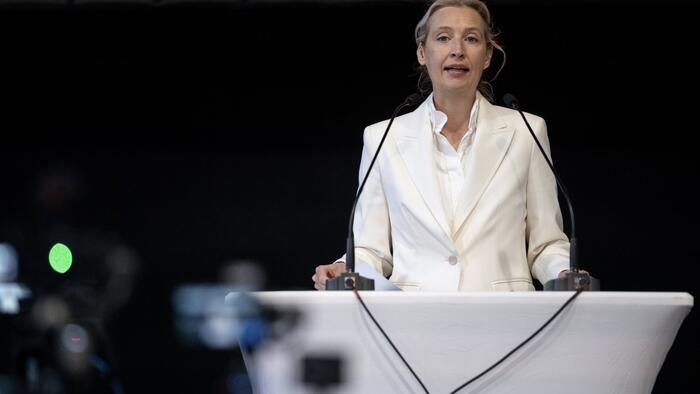
On February 13, Alice Weidel, the AfD’s charismatic co-chair, bounded onto the stage of a large auditorium in the southwest corner of Baden-Württemberg, accompanied by heavy metal riffs and cheers from a crowd of 2,000 supporters. The AfD hoped to double its previous vote share in this cradle of German engineering might by emphasizing its message about a rational energy policy. “Am achten März: Schmerz für Merz! [On the eighth of March, pain for Merz!]” was its optimistic, thrice-rhyming campaign slogan. Weidel has relentlessly denounced Germany’s trillion-euro investment in windmills and solar farms, which have radically decreased Germany’s energy output without even saving the environment, as the Left would define it. Germany has had to restart coal plants in order to supply the electrical grid during the winter doldrums, when the sun does not shine, and the wind does not blow.
Chancellor Merz has taken baby steps to reform Germany’s energy squeeze, to fend off the AfD nipping at his heels. But each step involves a self-cancelling concession to the CDU’s left-wing coalition partners. In early March, the government lifted a despised ban on gas-fired residential heating. It atoned for that violation of climate orthodoxy, however, by upping the amount of expensive biomethane required to be blended with the natural gas. Merz calls merely for tweaking Germany’s elaborate carbon tax and trading system, which he sees, according to the AfD, as a way to “discipline the citizens.” Only the AfD wants to abolish the carbon tax entirely.
Weidel’s ebullience at the February 13 campaign rally in Baden-Württemberg contrasted with her steely persona in the Bundestag. She mocked ongoing efforts to characterize the party as neo-Nazi and laughed off a left-wing heckler who demanded that she decamp for Switzerland, where she lives part-time with her Swiss-Sri Lankan wife. (So much for alleged conservative “phobias” about allegedly “marginalized” groups.) In the AfD, she said in response to the heckler, anyone can say what he wants.
Weidel illustrated the quotidian hypocrisy among the elites with a slide of the luxury Audi A8 diesel sedan used by the head of Germany’s The Left party (“Die Linke”), notwithstanding The Left’s platform of banning diesel fuel.
And then Weidel got to the heart of her speech: reclaiming Germany’s future.
“We need to give freedom back to our industrial concerns. . . . We must liberate them so that they decide what to produce and can make free decisions. The auto industry must decide what it manufactures. We want free competition so that you can decide what you buy. We want free enterprise back. . . . How can an industrial nation destroy the most modern nuclear energy in the world? We are the only country [to do that]. France, China, and the U.S. are building nuclear energy. Only Germany is blowing it up [literally, as a video projection showed]. That’s why we have the highest energy prices.”
“We’ve had it with the dilapidated politics of the Old Parties.”
Weidel hadn’t gotten the message that patriotism was an atavistic impulse. “Vote for the AfD out of love and responsibility for our country!” she urged in her peroration. “Out of love for our Fatherland. We want our Germany back, and we will take it back!”
The crowd was on its feet, roaring.
The AfD’s genial candidate for minister-president of Baden-Württemberg, Markus Frohnmaier, stepped up to the mic. In the land of Gottfried Daimler and Ferdinand Porsche, Frohnmaier said, people understand that their livelihoods are threatened not by the AfD, but by the Old Politics. “The Old Parties blame Trump or Putin for our economic woes. But we have done this to ourselves.”
Over 60 percent of the population of Pforzheim, where the AfD rally was held, has a migrant background, the second-highest level in Germany.
“You know the violent crime statistics,” Frohnmaier said.
“The people who believe that they can come to Germany, commit the most heinous crimes, and stay here? We’re going to hustle them [literally: dance them] to the Stuttgart airport, along with Interior Minister Martin Hess, and then we’re going to deport, deport, deport until the runway glows!”
Such language sends the elites into an ecstasy of anti-fascist self-righteousness. The AfD’s platform is clear, however. It seeks the return only of migrants deemed illegally present in the country, with a priority put on criminals and terror threats. It wants to end incentives for mass migration by restricting residency permits to those who are self-sufficient and not welfare-dependent. It welcomes citizens from abroad who seize the opportunities Germany offers and integrate into its mores.
Despite the best efforts of the mainstream media to suppress AfD support, the party charged ahead in Baden-Württemberg on March 8. It garnered close to 19 percent of the vote, up from nine percent in 2021. The Old Parties, by contrast, mostly treaded water, with the Greens tallying nearly 32 percent and the CDU around 30 percent. The election was, in fact, a Schmerz für Merz. The establishment is running scared. Party members faced the usual press blackout after the Baden-Württemberg election was called. Public television channel ARD gave long, probing interviews to representatives of parties that had garnered under five percent of the vote, and thus would not be included in parliament, while ignoring the third-highest vote-getter entirely.
For now, the firewall still stands in Baden-Württemberg, as it does nationally. If the CDU were serious about enforcing immigration laws in the state and liberating the local auto industry from crippling climate mandates, it would create a majority coalition with the AfD. Instead, Baden-Württemberg will be governed by yet another incoherent alliance, this time between the CDU and the Greens, the latter of which will stymie pro-conservative reform.
But the trend is unmistakable. Baden-Württemberg epitomizes Germany’s prosperous western heartland, whose voters are the most given to anti-AfD virtue signaling. The AfD’s momentum in the west is going to make it harder and harder to disenfranchise its supporters, especially if the youth vote keeps moving its way. (While the plurality of the 16- to 24-year-old vote in Baden-Württemberg (28 percent) unsurprisingly went to the Greens, the AfD bested the CDU with 18 percent of the youth vote, compared to the CDU’s 17 percent. In the east, that age bracket favors the AfD by large margins.)
And so the anti-AfD forces are ramping up their smears. A deputy with the German newspaper Bild regularly recycles the usual calumnies about the AfD in The Wall Street Journal in order to promote Chancellor Merz. Over the weekend, Filipp Piatov found a new angle: The AfD was defined by “intractable anti-Americanism.” Never mind that Weidel has consistently praised Donald Trump and the Make America Great Again movement as a model for Germany. Piatov’s evidence for the AfD’s alleged hostility to the U.S. was the party leadership’s ambivalence towards the current U.S. and Israeli war against Iran. But that stance is a natural outgrowth of the AfD’s Germany First position. The AfD has been anti-war and anti-interventionist long before the U.S. struck Iran on February 28, including regarding Germany’s involvement in the Ukraine conflict. Weidel and her AfD co-chair caution about the Iran war’s effects on German energy prices and on international migration flows. Others within the AfD, by contrast, have called for an unequivocal endorsement of the American-Israeli action. The issues posed by this Middle East conflagration are complex enough that an ideological ally like the AfD should be able to respectfully disagree with an American policy without being declared a foe.
At the same time that the AfD is being blasted for anti-American pacifism, it is being portrayed as a dangerous warmonger. According to The New York Times, European leaders worry that if Germany rebuilds its military, the new capacity could fall into the hands of the “far-right, anti-constitutionalist” AfD, which would take up where Hitler left off. In fact, the AfD objected to Merz’s lifting of Germany’s debt brake in order to increase military expenditures, at least if the government did not make commensurate cuts in welfare spending.
One can only speculate where the AfD would stand nationally if the press treated it fairly. It is up against the most powerful shame coalition in the West. But despite the absence of a conservative media ecosystem of the sort that the MAGA movement at present enjoys, it is steadily gaining ground. The reason, perhaps, is that it understands that to deny the ties that bind the members of a civilization together is to deny the existence of civilization itself.