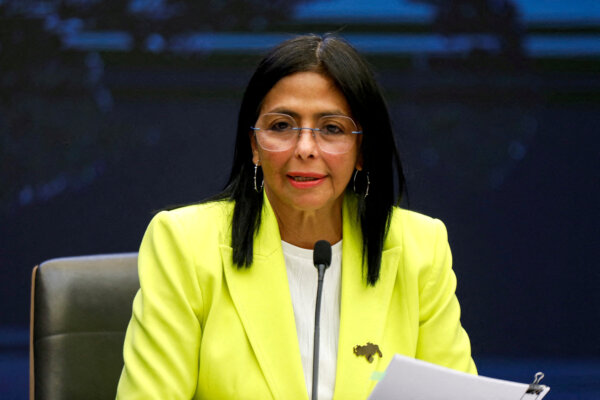
 Venezuela’s interim leader, Delcy Rodriguez, said on Jan. 7 that the South American nation is open to establishing new energy relationships based on commercial agreements and mutual benefit, marking a potential shift in policy following the removal of former leader Nicolás Maduro.
Rodriguez made the remarks during a meeting with members of Venezuela’s National Assembly of Venezuela in Caracas.
“Venezuela is open to energy relations where all parties benefit, where economic cooperation is very clearly defined in commercial contracts. That is our position, and the diversification of our energy relations,” she told the assembly.
She noted Venezuela’s large oil and gas reserves, adding that these resources must serve national development, as well as the development of other countries.
“This is how our oil industry was born, with an export-oriented vocation,” Rodriguez said.
Following Maduro’s removal, Rodriguez, who served as Maduro’s deputy, assumed interim leadership. U.S. authorities said Washington would exercise oversight of the transitional government.
Venezuelan Resources
Despite signaling openness to cooperation, Rodriguez framed Venezuela’s energy policy as a matter of sovereignty and law.
“We want to move toward a law on the rational use of energy,” she said on Jan. 7. “We are an energy power. We truly are. And that has brought us enormous problems.”
She said that foreign pressure on Venezuela historically centered on its hydrocarbon wealth.
“As you know, the energy voracity of the North wants the resources of our country. And we have denounced this,” Rodriguez said.
“All the false claims about drug trafficking, democracy, and human rights were not the real reasons. They were excuses. Because what has always been present is that Venezuela’s oil must be handed over to the Global North.”
U.S. President Donald Trump has said his administration plans to encourage U.S. oil companies to invest capital, technology, and operational expertise in Venezuela’s energy sector.
Trump said Venezuela could return to full production within 18 months, allowing the country to generate revenue needed to rebuild roads, power grids, and other infrastructure. After Maduro’s capture, the president warned Rodríguez that she could face worse consequences than Maduro if she didn’t “do what’s right” and seek to align the nation more with U.S. interests.
Trump said on Jan. 6 that the United States would soon receive 30 million to 50 million barrels of sanctioned Venezuelan oil from the South American nation.